Origin and evolution of the ETICS system from the post-war period to current European certification. Regulatory framework in Portugal (RCCTE, REH), APFAC's role in the sector and 2rf's position as a member.
Selection of dowels for mechanical fixing in ETICS systems in accordance with ETAG 014. Length per insulation thickness, drilling method per support, T and W diagrams, plastic and steel nails.
Selection of dowels for mechanical fixing in ETICS systems in accordance with ETAG 014. Length per insulation thickness, drilling method per support, T and W diagrams, plastic and steel nails.
The ETICS (External Thermal Insulation Composite System) is the result of more than seven decades of technical development in external thermal insulation for building facades. From the first systems using mineral wool protected by mortar in Sweden in the 1940s to today’s CE-marked certified systems, the evolution of ETICS has kept pace with the growing demands for energy efficiency in European construction.
In Portugal, the ETICS system — colloquially known as ‘capoto’ — has established itself as the leading technical solution for thermal insulation of façades, in both new builds and renovation projects. APFAC (the Portuguese Association of Mortar and ETICS Manufacturers), of which 2rf is a member, plays a key role in promoting best practice and professional standards within the sector.
From the post-war energy shortage to international isolation
The development of external wall insulation originated in post-World War II Europe. Fuel shortages and rising energy costs made insulation essential for achieving energy-efficient buildings. The need was clear: to reduce heating bills in cold climates.
In Sweden, during the 1940s, work began on developing an external insulation system using mineral wool protected by lime- and cement-based mortars. In the 1950s, the system spread to Germany and Switzerland. Central European countries, with older building stock in need of refurbishment and climates with greater thermal demands, adopted this solution due to its adaptability to different types of buildings and construction.
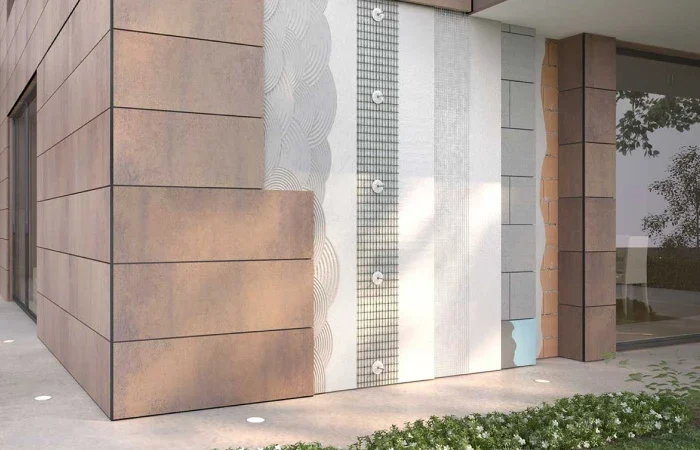
It was against this backdrop that thin-coat rendering systems reinforced with insulation boards were developed, which would come to be known as ETICS systems. The technical term — External Thermal Insulation Composite System — reflects the composite nature of the system: multiple layers with distinct functions that work together.
Technical developments and European certification
The development of ETICS has gone through three distinct phases. The first, up until the 1970s, focused on the development of insulation materials (EPS, XPS, mineral wool) and bonding and rendering mortars. The second, in the 1980s and 1990s, introduced the framework with anti-alkaline fibreglass mesh, finishing and starter profiles, and complementary mechanical fixing with wall plugs. The third, from the 2000s onwards, consolidated European certification and the standardisation of components.
The European Assessment Documents (EAD 040083-00-0404) set out the requirements for the certification of ETICS systems and the rules and test methods for approval. These documents, adopted by EOTA (European Organisation for Technical Assessment), define the product characteristics, assessment methods and factory production control conditions. Validation is carried out by notified external bodies.
The CE marking on ETICS systems guarantees compliance with these European requirements and allows products to circulate freely within the European market. For professionals, the CE marking confirms that the system and its components have been assessed and approved in accordance with harmonised technical criteria.
ETICS in Portugal: regulations and market growth
In Portugal, the uptake of ETICS has accelerated in line with changes to thermal regulations. The RCCTE (Regulation on the Thermal Performance of Buildings), published in 1990 and revised in 2006, established minimum thermal insulation requirements for buildings for the first time. The REH (Regulation on the Energy Performance of Residential Buildings), which replaced it in 2013, significantly strengthened these requirements, with maximum thermal transmittance (U) values differentiated by climate zone.
The REH, supplemented by Ministerial Order 379-A/2015, sets out the maximum U-values for opaque vertical external envelopes (walls) by winter climate zone (I1, I2, I3). With each regulatory review, the minimum insulation thicknesses increase, making the ETICS system progressively more relevant as a construction solution.
The growth of the ETICS market in Portugal also reflects the increasing importance of renovation in the construction sector. ETICS is particularly well suited to renovation projects because it is applied from the outside, without the need to evict occupants and without reducing the living space.
APFAC’s role in the sector
APFAC — the Portuguese Association of Mortar and ETICS Manufacturers — is the trade association that brings together manufacturers and operators in the sector in Portugal. The association promotes the quality and safety of ETICS systems, helping to ensure that all entities in the sector comply with technical standards and regulations.
Among APFAC’s initiatives, the publication of the ETICS Manual stands out; this reference document describes the system’s components, application procedures and construction details. The ETICS Manual forms the technical basis for the training of applicators and for the specification of solutions by designers and engineers.
APFAC also organises training courses, technical conferences and sector-specific publications. The documentation on defects in ETICS systems, available on the association’s website, serves as a diagnostic tool for professionals encountering problems in existing systems.
2rf as an APFAC member
2rf is a member of APFAC and operates in the sector with an exclusive focus on complementary components for ETICS systems: starter, corner, drip edge and expansion joint profiles; mechanical fixing anchors; fibreglass mesh; fixings; application tools and professional machinery. It does not manufacture insulation or finishing systems.
Whilst APFAC’s member manufacturers of ETICS systems supply the complete system (mortars, insulation, finish), 2rf supplies the technical components that sit between the insulation and the finish — the accessories that ensure protection, fixing, framing and watertightness at the points where the system’s performance is most critical.
The compliance of 2rf components with European technical standards (ETAG 014 for wall plugs, EAD 040083-00-0404 for mesh, CE marking across the entire range) is in line with the quality and certification principles that APFAC promotes within the sector.
Outlook for the ETICS sector in Portugal
The European Energy Performance of Buildings Directive (EPBD) sets out to make nearly zero-energy buildings (NZEBs) the standard for new construction. The transposition of this directive in Portugal will result in progressively more stringent thermal requirements, with direct consequences for insulation thickness and the specification of ancillary components.
Increased insulation thickness requires longer anchors, wider starter profiles and reinforced mechanical fastening. The correct specification of these components becomes increasingly important as systems grow more complex and performance requirements become more stringent.
→ APFAC — Portuguese Association of Manufacturers of Mortar and ETICS → ETICS Manual — Download → View ETICS 2rf components