
Origin and evolution of the ETICS system from the post-war period to current European certification. Regulatory framework in Portugal (RCCTE, REH), APFAC's role in the sector and 2rf's position as a member.
Selection of dowels for mechanical fixing in ETICS systems in accordance with ETAG 014. Length per insulation thickness, drilling method per support, T and W diagrams, plastic and steel nails.
Selection of dowels for mechanical fixing in ETICS systems in accordance with ETAG 014. Length per insulation thickness, drilling method per support, T and W diagrams, plastic and steel nails.
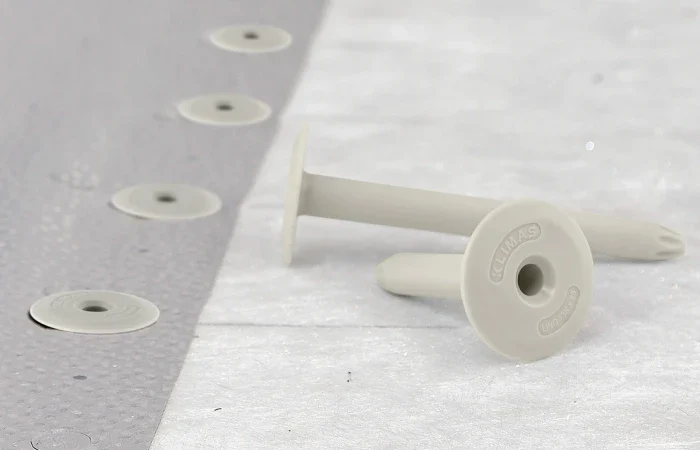
Mechanical fixing with dowels is additional to gluing the insulating boards, never an alternative. The dowels are applied after the bonding mortar has hardened and must fulfil the requirements of ETAG 014. Their function is to guarantee the long-term stability of the insulation, complementing the adhesion provided by the bonding mortar.
The correct bushing selection depends on the type of support, the thickness of the insulation and the exposure conditions of the building. Improper specification results in insufficient fixing which can jeopardise the stability of the system over time.
The relationship between bonding and mechanical fixation
Bonding is the basis of adhesion between the insulating board and the substrate. The bonding mortar is applied to the board using one of two methods: total bonding (mortar spread over the entire surface, used on concrete substrates or flat plaster with a No. 10 notched trowel) or perimeter bonding with dots (mortar spread around the perimeter and in dots or strands in the centre, guaranteeing a bonding area equal to or greater than 60%, used on masonry substrates).
Mechanical fixing complements gluing. In cases where perimeter gluing with dots is chosen, the mechanical fixing must coincide with areas where there is gluing mortar on the board. The dowels are only applied when the boards are sufficiently adhered to the substrate.
Drilling method per type of support
The type of support determines the drilling method:
For reinforced concrete and solid brick supports, drilling is carried out using the hammer method. These supports offer high and consistent anchoring capacity.
For hollow brick supports, the normal method is used (without percussion). Hammering can damage the internal geometry of the brick and compromise the anchoring capacity. The geometry of the brick perforations (vertical or horizontal) directly influences the behaviour of the dowel.
For stone, block or aerated concrete masonry supports, the anchoring conditions vary significantly depending on the density and homogeneity of the material. For heterogeneous substrates, in situ pull-out tests may be necessary to validate the actual load capacity of the fixing.
Bushing length
The length of the dowel must be at least 3 cm greater than the thickness of the insulating board. This length ensures the minimum anchoring depth in the support, regardless of the type of board used.
For 60 mm EPS: minimum bushing length = 60 + 30 = 90 mm. For 80 mm EPS: minimum length = 80 + 30 = 110 mm. For 100 mm EPS: minimum length = 100 + 30 = 130 mm. For 120 mm EPS: minimum length = 120 + 30 = 150 mm. For 160 mm EPS: minimum length = 160 + 30 = 190 mm.
The range of lengths available on the market varies from 70 to 430 mm, covering insulation thicknesses from 20 to 400 mm. With the increase in regulatory thermal requirements and the consequent increase in insulation thicknesses, bushing lengths above 150 mm are becoming increasingly common.
Distribution and fixing diagrams
The dowels are distributed around the perimeter of the board and in the centre, in a quantity of 6 to 8 per m². The exact number of fixings depends on a number of factors in accordance with ETAG 014: the pull-out resistance of the fixing on the support, the type and quality of the insulating board, the height of the building, and the position, location and shape of the building. In specific conditions (tall buildings, coastal areas, peripheral areas of the façade with greater wind suction) additional fixings may be required.
Two diagrams are used to lay out the mechanical fixings:
T-Scheme
For Expanded Polystyrene (EPS), Expanded Cork Board (ICB) and Extruded Polystyrene (XPS) boards. The dowels are applied at all the board interceptions and joints, with an additional dowel at the centre of each board. This scheme distributes the fixings at the meeting points between slabs, where the load is shared.
W diagram
For Mineral Wool (MW) boards. Each board is fixed with 3 dowels, applied at a distance of around 5 to 10 cm from the sides of the board. This scheme is specific to mineral wool because the mechanical characteristics of this insulation require a different load distribution to EPS.
Procedure for applying mechanical fastening
The application follows a defined sequence. The dowel is inserted into the previously drilled hole. Depending on the type of dowel, the nail (plastic or steel) is hammered or screwed in. The dowels must be embedded in the insulating panel - they must not protrude or be on the surface of the insulation.
After fixing, check that each bushing is correctly anchored to the bracket. Bushings that are damaged or loose for any reason must be removed. The new fixing is placed in a new hole. The remaining hole is plugged with insulating material or foam, never with mortar (which would create a punctual thermal bridge).
Plastic or steel nail
The plastic nail (reinforced polymer) eliminates thermal bridging at the fixing point. The thermal conductivity of plastic is significantly lower than that of steel, reducing heat transfer through the fixing point. It is suitable for most common situations in buildings of moderate height, with supports of good anchoring capacity.
The steel nail (galvanised or stainless steel) offers superior pull-out resistance. It is suitable for four situations: buildings over 8 metres high, coastal areas or areas with high winds, substrates with lower anchoring capacity (low-density hollow bricks, blocks), and systems with mineral wool insulation. In the latter case, the steel nail fulfils an additional fire safety function - it keeps the boards fixed to the substrate even when the bonding mortar loses capacity with heat.
Telescopic bushes
For insulation thicknesses greater than 160 mm, telescopic bushes simplify application. The telescopic design allows the pressure disc to sit on the surface of the insulation without the need to cut and replace a plug. This configuration reduces application time and eliminates residual thermal bridging of the hole.
Telescopic bushes are compatible with all current types of insulation (EPS, XPS, mineral wool) and transfer the load directly to the structural support.
Preparing the support
Before the dowels are applied, the substrate must be in suitable condition. Surfaces must be mechanically resistant, free of areas that are coming loose. The substrates must not show planimetric irregularities of more than 1 cm when checked with a ruler over a distance of 2 metres.
On new concrete substrates, at least one month must have elapsed before the system is applied. On plastered substrates, the plaster must be well adhered and have adequate surface consistency. The ETICS system should not be applied to walls subject to rising damp through capillarity.
2rf range
2rf offers plastic and steel nail plugs, telescopic plugs and special fixing solutions (wooden supports, chemical glue, repair), in lengths from 70 to 430 mm. All references are ETAG 014 compliant and CE marked. Plugs and concealment discs available for all diameters. The range is available in the 2rfpro.pt online shop.