
Origin and evolution of the ETICS system from the post-war period to current European certification. Regulatory framework in Portugal (RCCTE, REH), APFAC's role in the sector and 2rf's position as a member.
Selection of dowels for mechanical fixing in ETICS systems in accordance with ETAG 014. Length per insulation thickness, drilling method per support, T and W diagrams, plastic and steel nails.
Selection of dowels for mechanical fixing in ETICS systems in accordance with ETAG 014. Length per insulation thickness, drilling method per support, T and W diagrams, plastic and steel nails.
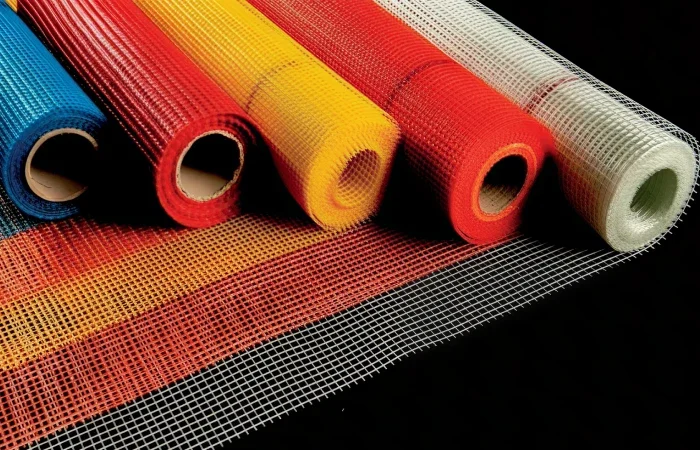
The fibreglass mesh forms the reinforcement for the base coat of the ETICS system. Embedded between two layers of rendering mortar, it redistributes the thermal, mechanical and shrinkage stresses acting on the system, preventing cracks from propagating to the surface of the finish.
The choice of mesh, the application procedure and the correct positioning within the mortar bed directly affect the integrity of the reinforced base layer and, consequently, the durability of the system.
Technical specifications in accordance with EAD 040083-00-0404
The fibreglass mesh for use in ETICS systems must be alkali-resistant and comply with the specifications of EAD 040083-00-0404. The alkali-resistant treatment consists of impregnating the mesh with resins that protect it against chemical attack from the alkalis present in cement and lime mortars. Without this treatment, the fibreglass degrades over time through contact with the mortar, losing its mechanical strength.
The compliance criteria are cumulative. The tensile strength after accelerated artificial ageing by immersion in an alkaline solution shall not be less than 20 N/mm. This strength shall not be less than 50% of the tensile strength in the as-manufactured condition. Both criteria must be met simultaneously.
The relevant properties to consider when selecting the mesh include: mesh aperture dimensions (mm), fabric weight (g/m²), longitudinal and transverse tensile strength (N/mm), longitudinal and transverse elongation at break, and thickness. The standard weight for reinforced mesh in ETICS systems is 160 g/m² (±8%).
Procedure for applying the reinforced base layer
The rendering mortar is applied using a stainless steel trowel (smooth-faced), to a uniform thickness of approximately 4 mm, in two coats.
First layer and integration of the network
The first layer is applied using a 50 cm notched trowel (6 mm notches), to a thickness of approximately 2 mm. The fibreglass mesh is laid wet-on-wet over this layer, stretched taut and embedded in the mortar.
The positioning of the mesh is crucial: it must be placed halfway through the total thickness of the rendering mortar. The mesh must not be pressed flat against the surface of the insulation board — there must be mortar both below and above the mesh. Nor should the mesh remain on the surface of the second layer, as this would leave it visible or insufficiently protected.
Overlap between tracks
To ensure continuity of the reinforcement framework, the overlap between mesh strips must be at least 10 cm. This overlap applies to all joints, including those where the mesh connects to the edge and reinforcement profiles. Overlaps of less than 10 cm create areas of discontinuity in the meshwork, which are prime locations for cracking.
Second layer
Once the first layer has set, the second layer (also 2 mm thick) is applied, forming a smooth, even surface that completely conceals the mesh. The total thickness of the reinforced base layer must be at least 4 mm.
Quality control checks at this stage include: a mortar thickness of at least 2 mm in the first layer, positioning of the mesh away from the surface of the insulation board, 10 cm overlaps of the mesh, a taut mesh surface without bumps or ripples, the mesh not visible after the second layer, a consistent mortar surface without creases, and an overall thickness of at least 4 mm.
Additional support in areas with greater needs
Foundation
The base area (typically up to 2 metres above ground level) is subject to greater exposure to mechanical impact, water splashes and rising damp. A second reinforcement mesh, with a higher weight per square metre than the standard mesh, can be installed in this area.
The second reinforcement mesh is applied without overlapping the first mesh and only once the base layer reinforced with the standard mesh has set sufficiently. The setting time depends on weather conditions and should be checked in the mortar manufacturer’s instructions.
Corner openings
Diagonal reinforcement meshes must be inserted at the corners of doors and windows, and fitted to the frame before the reinforced concrete is poured. The mesh strips measure approximately 200×300 mm and are fixed with their edges directly at the corner of the opening, at an angle of approximately 45°. Pre-formed mesh can be used for this application.
This diagonal reinforcement prevents cracking that develops from the corners of the spans — one of the most common defects in ETICS systems, resulting from the concentration of stresses in these areas.
Link to profiles
The mesh incorporated into the corner, drip edge and finishing profiles must overlap the base layer mesh by at least 10 cm. This overlap ensures the continuity of the framework at the transition between the main surface and the specific point protected by the profile.
Terms and conditions
The application of the reinforced base coat must comply with the general weather conditions specified for the ETICS system. The ambient temperature must not exceed 30°C or fall below 5°C. The application must not be carried out in strong winds, rain or in direct sunlight.
The substrate (insulation boards that have been bonded and, where applicable, mechanically fixed) must be stable and the bonding mortar must have set before starting the rendering work. The flatness of the insulation surface must be checked and corrected beforehand — in the case of EPS boards, sanding with a sanding block removes irregularities and protrusions.
Types of network by application
Standard ETICS mesh (160 g/m²)
Mesh for reinforced busbar systems in external thermal insulation systems. 100% fibreglass strands with double twist and anti-alkali resin impregnation. Weight: 160 g/m² (±8%). Complies with the criteria of EAD 040083-00-0404.
Reinforcement mesh
Glass fibre mesh with a weight exceeding 160 g/m², for use as a second reinforcement layer in high-impact areas (foundations, ground floors in urban areas, and façades in high-traffic areas).
Reinforcement mesh
A lightweight fibreglass mesh, for use in finishing coats and in situations where the thickness of the coating does not allow for the incorporation of standard mesh.
Waterproofing mesh
Fine-mesh fabric for reinforcing waterproofing products: liquid membranes, liquid rubbers and two-component waterproofing systems. Suitable for use on balconies, terraces and at material junctions.
2rf range
2rf supplies certified ETICS mesh (160 g/m², product codes R.ETICS and RF.PLUS), reinforcement mesh, fleece and waterproofing mesh (product code RI50). All ETICS products feature anti-alkali treatment in accordance with EAD 040083-00-0404. The range is available from the 2rfpro.pt online shop.