
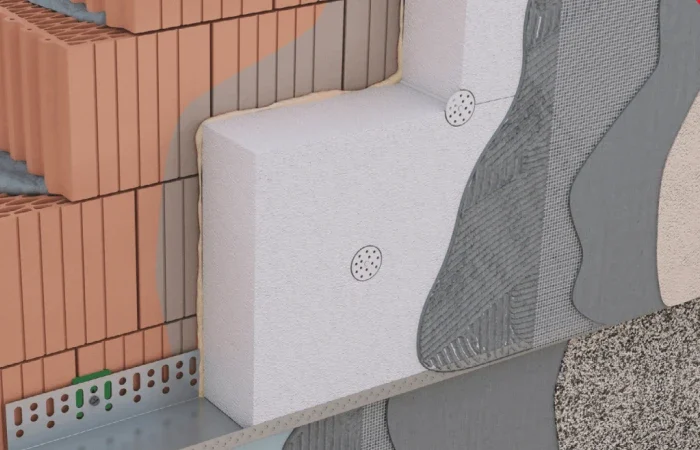
Origin and evolution of the ETICS system from the post-war period to current European certification. Regulatory framework in Portugal (RCCTE, REH), APFAC's role in the sector and 2rf's position as a member.
Selection of dowels for mechanical fixing in ETICS systems in accordance with ETAG 014. Length per insulation thickness, drilling method per support, T and W diagrams, plastic and steel nails.
Selection of dowels for mechanical fixing in ETICS systems in accordance with ETAG 014. Length per insulation thickness, drilling method per support, T and W diagrams, plastic and steel nails.
The profiles are accessories of the ETICS system that are applied to the individual points of the façade. Their function is to ensure mechanical protection, watertightness and finish in areas where the system changes direction, meets a building element or is exposed to specific forces. Each type of profile responds to a different condition: starting at the base, reinforcement at the edges, drainage at the lintels, absorption of movement at the joints and finishing at the connections to window frames.
The correct selection and application of profiles directly affects the durability of the system in these areas. The majority of pathologies in ETICS systems originate in the singular points, not in the ordinary surfaces of the façade.
Profile types and function by position on the façade
The ETICS system uses the following types of profiles and accessories: starter profile, trim profile, drip profile, corner profile, window profile, expansion joint profile (including V-shaped expansion joint profile), and elastic sealing material.
Start profile
The starter profile ensures the levelling and mechanical and moisture protection of the first row of insulating boards. It is installed horizontally in the plane of the wall, at a minimum height of 15 cm above the finished floor. It is fixed to the substrate using tapit, with a maximum spacing of 30 cm between fixing points.
The width of the profile corresponds to the thickness of the insulation to be applied. For 80 mm EPS, an 80 mm starter profile is used. The range of available widths varies from 20 to 200 mm, covering all current insulation thicknesses (EPS, XPS, mineral wool, expanded cork agglomerate).
There must be a gap of 2 to 3 mm between adjacent profiles to allow for thermal expansion of the material. There should be no overlap between profiles. The connection between adjacent profiles is made with connectors that maintain alignment without blocking the expansion movement. When the support has planimetric irregularities, spacers are used between the profile and the wall to ensure levelling.
The insulating boards are glued together from the level defined by the starting profile. The boards are laid from the bottom up, with the larger side in a horizontal position, in counter-sections (vertical joints at least 25 cm apart).
Corner profile
The corner profile protects the edges of the façade (corners of the building, edges of window and door openings) against mechanical impact and stress concentration. The fibreglass mesh incorporated into the profile is integrated into the reinforced base layer, creating a continuous reinforcement zone at the edge.
The corner profiles are glued to the insulating board with coating mortar, pressing against the corner until the mortar flows back through the pre-existing holes in the profile. They must not be fixed with dowels or nails. There should be no overlap between adjacent corner profiles. They must be applied before the current surfaces are reinforced.
At the corners of window and door openings, diagonal reinforcing mesh must be applied to the support before the reinforced bar. The mesh strips are approximately 200×300 mm in size and are applied at an inclination of around 45°, with the edges of the strips directly at the corner of the opening. Pre-moulded nets can be used.
Pendant profile
The drip profile is positioned on the lintels (tops) of window and door openings. Its function is to interrupt the flow of rainwater down the façade, preventing it from sliding down the surface of the cladding below the lintel. The gutter integrated into the profile diverts the water perpendicularly away from the wall.
The built-in fibreglass mesh integrates the profile into the base layer of the system. The choice between visible and concealed guttering depends on the desired finish, but the presence of the gutter is a functional requirement that should not be omitted.
Expansion joint profile
Existing expansion joints in the façade must be respected and never covered by the insulating boards. The expansion joint profile is made up of side flaps with fibreglass mesh and a deformable, UV-resistant central membrane that absorbs structural and thermal movements without transferring stresses to the cladding.
Expansion joints are mandatory on façades longer than 8 linear metres, at transitions between different building bodies, over existing structural joints and when the façade changes orientation. The membrane accommodates joints from 5 to 25 mm wide, depending on the reference selected. Available in flat façade and corner versions.
Window profile
The window profile ensures the connection between the ETICS system and the window frame. At the ends with rigid boundary elements (frames, sills, eaves, walls), a joint of at least 5 mm must be provided so that it can be filled with elastic sealant material compatible with the material of the insulating board.
Application procedure
The application of edge reinforcement profiles (corners, drip edges, edges of gaps) follows a specific procedure. The profiles are glued to the insulating board with coating mortar. The profile is pressed against the corner, causing excess adhesive to flow back through the pre-existing holes. No dowels or nails are used for fixing. There must be no overlap between adjacent profiles.
The profiles are applied before the insulating boards are covered. The correct sequence is: installation of the starter profiles → gluing the insulating boards → application of the corner, drip edge and finishing profiles → diagonal reinforcements at the corners of the spans → reinforced busbar with fibreglass mesh.
If a second reinforcing mesh is required (in the basement area, for example), it should be applied without overlapping the first and only after the base layer has hardened sufficiently with the standard mesh.
Sealing the edges with contour elements
After the final finish has dried, the finished surface must be sealed with the boundary elements (frames, platbands, purlins) by applying a bead of mastic-type elastic sealing material. The sealant must be compatible with the material of the insulating board and the finish applied.
This sealing is the last operation of the system at the transition points and is decisive for long-term watertightness. Failure to seal or the use of an incompatible sealant results in seepage at the points of contact between the ETICS system and adjacent elements.
Quality control checks
According to the worksheet for ETICS systems, the checks at the single points include: confirming that the trims have been executed as planned, checking the window trim profiles, checking the corner profiles in the openings and at the corners of the building, checking the reinforcement with 45° mesh at the corners of the openings, checking the expansion joint profiles (where applicable), and confirming that the joints have been sealed with rigid elements.
Selection criteria
The selection of the profile depends on the position on the façade (which determines the type), the material of the support (which can influence the fixing of the starter profile), and the level of exposure of the area (which determines the range). Aluminium profiles offer greater rigidity and mechanical resistance. PVC profiles adapt better to irregularities in the substrate and are a more economical option for less demanding areas.
2rf range
2rf offers starter profiles, corner profiles, drip edges, expansion joints, technical profiles (including window profiles and sill profiles) and accessories (connectors, spacers, tapits) in aluminium and PVC. All references are technically compliant and CE marked. The range is available for consultation in the 2rfpro.pt online shop.